
Sub-Total: $0.00
7 Powerful Secrets of Equine Ferroptosis Protection: Omega-3 Chia Seed Defense
Equine ferroptosis protection is rapidly emerging as one of the most critical frontiers in performance horse nutrition. As we push our equine athletes to their physical limits, the cellular stress they endure requires more than just basic antioxidant support. Recent 2026 research has uncovered exactly how specific nutritional interventions—particularly omega-3 rich chia seeds, trace minerals, and targeted phytocannabinoids—work synergistically to protect horses at the most fundamental cellular level.
Understanding Equine Ferroptosis Protection
In this comprehensive breakdown of our Cycle 11, Day 1 research, we explore the powerful intersection of gut microbiota fermentation, trace mineral enzyme activation, and endocannabinoid signaling. We will examine exactly how the alpha-linolenic acid (ALA) in chia seeds delivers equine ferroptosis protection, how yeast culture metabolically trains the immune system, and how manganese powers the brain’s primary antioxidant defense.
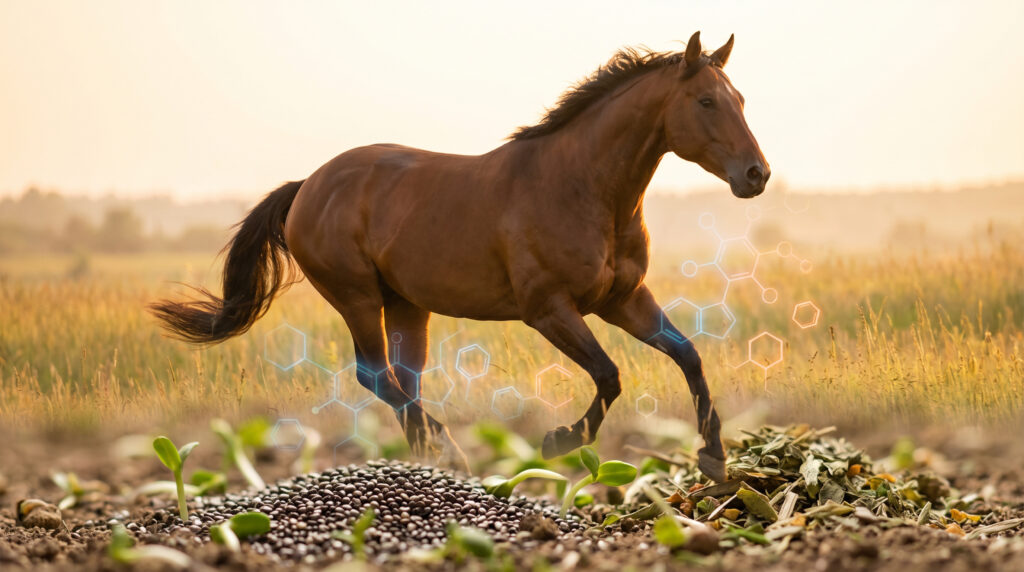
The NutriSana EQ Approach to Equine Ferroptosis Protection
Chia Seed Meal: The Gut Microbiota-Iron-Ferroptosis Axis
Chia seed meal serves as the foundational ingredient in our NutriSana EQ Core Formula, providing 50,000 mg of the richest plant-based source of alpha-linolenic acid (ALA). While chia has long been valued for its coat-enhancing properties, a groundbreaking January 2026 study published in Frontiers in Microbiology has fundamentally reframed how these omega-3 fatty acids protect the equine body [1].
The research demonstrated that chia seed oil mitigates metabolic damage specifically through the gut microbiota-iron-ferroptosis axis, offering a direct pathway to equine ferroptosis protection [1]. Ferroptosis is a form of iron-dependent, non-apoptotic cell death driven by the accumulation of lipid peroxides. When a performance horse experiences metabolic stress from intense training or travel, it induces gut dysbiosis. This dysbiosis leads to systemic inflammation and iron overload, indicated by elevated serum ferritin. This excess catalytic iron accelerates the Fenton reaction, intensifying lipid peroxidation and depleting Glutathione Peroxidase 4 (GPX4), which ultimately triggers ferroptosis [1].
Chia seed intervention disrupts this destructive cascade at multiple levels. The study found that it reshaped the gut microbial composition to restore balance, normalized ferritin expression to alleviate iron overload, and directly suppressed ferroptosis by preserving GPX4 activity [1]. Notably, when researchers depleted the microbiome using antibiotics, the protective effects of chia were severely attenuated. This proves that a healthy gut microbiome is the mandatory conduit for chia’s anti-ferroptotic benefits, making gut support essential for true equine ferroptosis protection [1].

Saccharomyces cerevisiae: Transcriptomic Immune Orchestration
To support the gut environment required for equine ferroptosis protection, NutriSana EQ includes 5,000 mg of Saccharomyces cerevisiae yeast culture. While yeast is commonly understood simply as a prebiotic for digestive health, a December 2025 transcriptomic analysis in the journal Animals revealed its precise mechanism of action in the liver and immune system [2].
The study demonstrated that compound yeast culture significantly improved liver tissue architecture and enhanced systemic antioxidant defenses, including total superoxide dismutase (T-SOD) and glutathione peroxidase (GSH-Px) [2]. Through Weighted Gene Co-expression Network Analysis (WGCNA), researchers identified that yeast culture actively upregulates the PI3K-AKT signaling pathway [2]. It specifically targeted hub genes such as PTPRC (responsible for immune recognition), CD86 (driving T-cell activation), and ITGAV (regulating cell adhesion) [2]. This confirms that yeast culture does not merely “boost” immunity; it metabolically trains the equine immune system to maintain homeostasis under intense stress.
Manganese: The Gut-to-Brain Antioxidant Cofactor
Manganese is often overlooked in traditional equine nutrition programs, but a December 2025 comprehensive review from Cornell University, published in Frontiers in Physiology, highlighted its non-negotiable role in cellular survival and its contribution to equine ferroptosis protection [3].
Manganese serves as the obligate cofactor for Manganese Superoxide Dismutase (MnSOD), the primary scavenger of reactive oxygen species within the mitochondria [3]. The review noted that MnSOD knockout is lethal to neonatal models, while partial deficiency results in severe oxidative stress and DNA damage [3]. Furthermore, the research identified a novel role for manganese in the Golgi apparatus, where it is essential for the glycosylation of proteins via the TMEM165 transporter [3]. Because manganese absorption is heavily influenced by the gut microbiota, the inclusion of chia and yeast culture in NutriSana EQ directly supports the bioavailability of this critical trace mineral, ensuring the mitochondria have the tools they need to prevent oxidative collapse [3].
PhytoSana CBD: Endocannabinoid Restoration & Terpene Defense
Cannabidiol (CBD): Rescuing Age-Associated Cognitive Decline
While NutriSana EQ builds the structural and metabolic foundation, our PhytoSana CBD line provides targeted neuroprotection. The endocannabinoid system undergoes significant degradation during the aging process, affecting older performance horses and senior rescues alike. An April 2026 study published in bioRxiv mapped the exact parameters of this decline and demonstrated how CBD intervention can reverse it [4].
Researchers found that levels of 2-arachidonoylglycerol (2-AG)—the brain’s primary endocannabinoid—and its synthesizing enzyme (DAGL-α) are significantly reduced in the medial prefrontal cortex of aged models [4]. This decline correlates directly with mood and memory impairments, accompanied by reduced expression of CB1 and CB2 receptors on microglia [4]. Consequently, these aged microglia enter a pro-inflammatory state characterized by increased HMGB1-TLR4-NF-κB signaling and an excitotoxic imbalance (elevated glutamate, reduced GABA) [4].
Intraperitoneal administration of CBD to aged subjects successfully reversed these mood and memory deficits [4]. Mechanistically, CBD restored CB1 and CB2 receptor expression, attenuated the inflammatory HMGB1-TLR4-NF-κB cascade, and normalized the glutamate-GABA balance in the prefrontal cortex [4]. This establishes CBD not just as an anti-inflammatory agent, but as a critical tool for restoring endocannabinoid tone and promoting healthy brain aging in senior horses [4].
Alpha-Pinene: Dual Joint and Cardiovascular Protection
Alpha-pinene is widely recognized as a bronchodilator that supports equine respiratory health, but a March 2026 study in Inflammopharmacology revealed its profound systemic protective effects [5].
In an adjuvant-induced arthritis model, alpha-pinene significantly ameliorated paw thickness, joint stiffness, and arthritic scoring while restoring endogenous antioxidants (SOD, CAT, GSH) and reducing pro-inflammatory cytokines (TNF-α, IL-6, IL-1β) [5]. Histopathological analysis confirmed it alleviated bone and cartilage erosion, pannus formation, and synovial hyperplasia [5].
Crucially, this was the first study to link alpha-pinene’s anti-arthritic effects directly to the reduction of atherosclerosis risk [5]. Alpha-pinene significantly reduced asymmetric dimethylarginine (ADMA), a major cardiovascular risk marker, by increasing the expression of ADMA-degrading enzymes (DDAH and CST) [5]. This dual action makes alpha-pinene a highly valuable terpene for managing systemic inflammatory conditions that threaten multiple organ systems simultaneously in the performance horse.
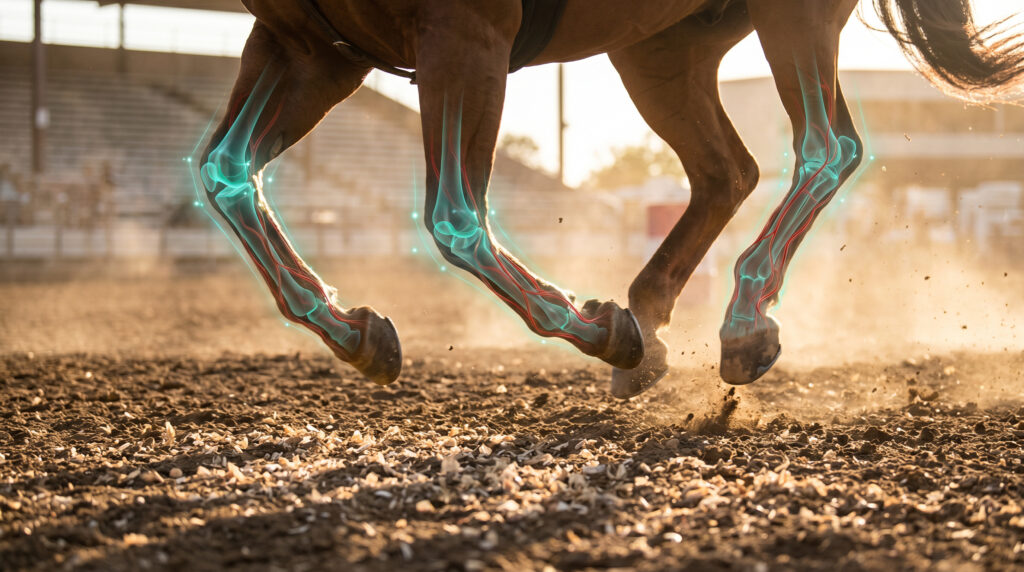
Synergy Spotlights: The Ultimate Equine Ferroptosis Protection Strategy
The true power of the NutriSana EQ and PhytoSana CBD protocol lies in how these ingredients interact to create a comprehensive shield for the equine athlete.
- The Ferroptosis Defense Network
Our protocol provides a triple-layered approach to equine ferroptosis protection. Chia Seed Meal’s ALA restores GPX4 activity to prevent lipid peroxidation [1]. Manganese powers MnSOD to neutralize mitochondrial superoxide before it can trigger the Fenton reaction [3]. Finally, Saccharomyces cerevisiae yeast culture enhances T-SOD and GSH-Px to provide comprehensive systemic antioxidant defense [2]. Together, they create an impenetrable barrier against iron-dependent cell death. - The Gut-Brain Mineral Axis
The absorption and utilization of trace minerals are heavily dependent on gut health. Chia’s ALA reshapes the gut microbiota, which improves the intestinal absorption of manganese [1] [3]. Once absorbed, manganese is transported to the brain to power MnSOD for neuronal protection [3]. Simultaneously, CBD restores CB1 and CB2 receptors on microglia, attenuating neuroinflammation and protecting the cognitive architecture [4]. - The Joint-Cardiovascular Protection Convergence
Chronic joint inflammation often carries secondary cardiovascular risks. Alpha-pinene directly addresses this by reducing arthritis markers while simultaneously lowering ADMA to protect against vascular damage [5]. CBD complements this by normalizing excitotoxic neurotransmitter imbalances [4], while chia’s omega-3s modulate systemic inflammation at the source [1]. Together, this combination delivers joint, cardiovascular, and neuroprotection from a single integrated protocol.
Ready to upgrade your horse’s nutritional foundation? Explore the complete NutriSana EQ Core Formula and learn how to implement these cutting-edge scientific principles in your barn today.
References
[1] Wang, Y., et al. (2026). Modulating iron metabolism and gut microbiota: the therapeutic potential of Chia Seed Oil in obesity-related diabetes. Frontiers in Microbiology. Read the full study [2] Li, X., et al. (2025). Immune-Modulatory Mechanism of Compound Yeast Culture in the Liver of Weaned Lambs. Animals. Read the full study [3] Zou, Y., et al. (2025). Gut to brain: essential micronutrient and trace element manganese transport, function and toxicity. Frontiers in Physiology. Read the full study [4] Kesharwani, A., et al. (2026). Cannabidiol rescues age-associated cognitive decline in mouse model. bioRxiv. Read the full study [5] Ali, K., et al. (2026). α-Pinene alleviates inflammatory responses and oxidative stress in freund’s complete adjuvant induced arthritic rat model and associated risk factors of atherosclerosis. Inflammopharmacology. Read the full study
