
Sub-Total: $0.00
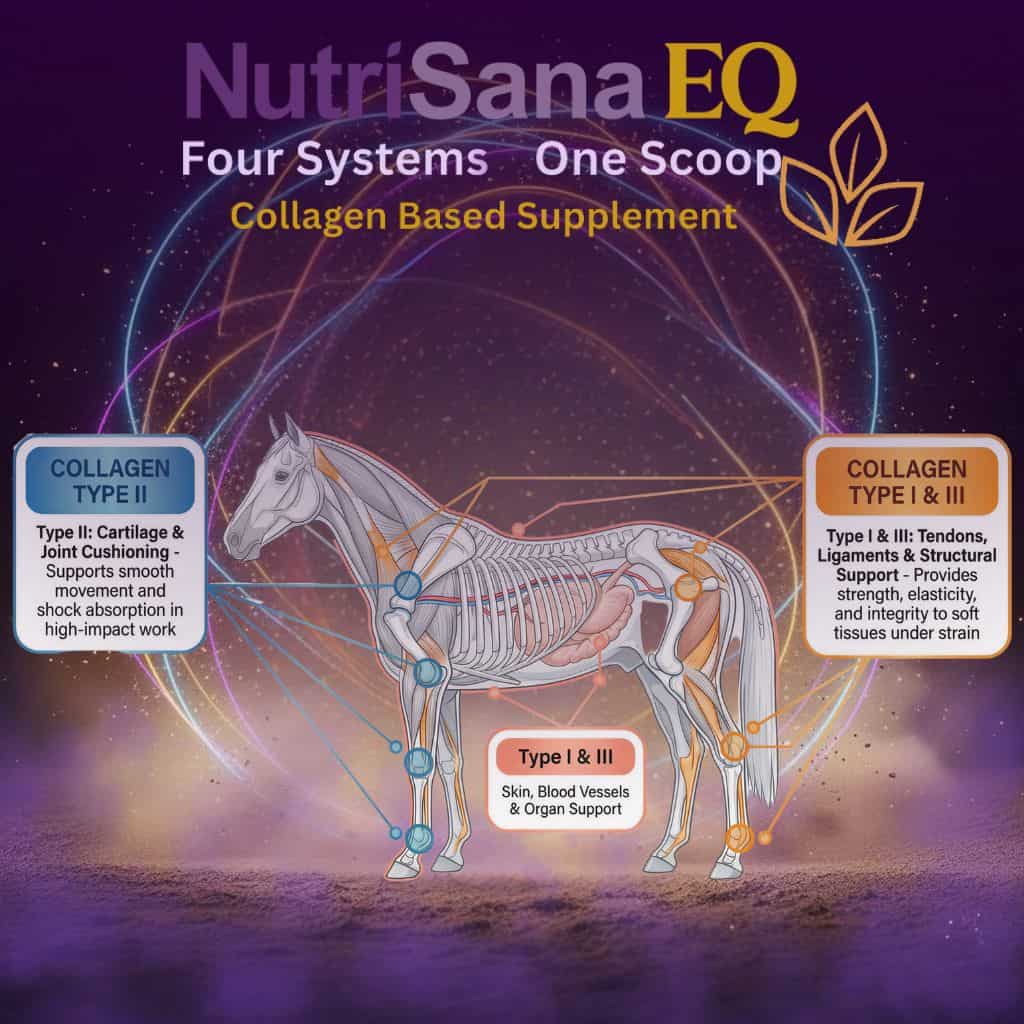
Hydrolyzed Collagen Type II vs NutriSana EQ CORE Collagen Matrix (Types I, II & III)
Type II collagen horses is a popular choice for joint cartilage support and its a solid ingredient. But performance horses dont just stress cartilage. They load the entire system: joints, tendons, ligaments, and connective tissue. Thats why NutriSana EQ CORE uses a Collagen Matrix for horses (Types I, II & III) to support the whole machine, not just one part.
If youve ever compared labels and thought, Wait isnt Type II collagen the joint one? youre not wrong.
Hydrolyzed Collagen Type II (alone): what it does best
Hydrolyzed Collagen Type II targets joint cartilage first focused tool. Its great at supporting the shock-absorbing cushion between bones.
Type II collagen is the primary collagen in articular cartilage (the smooth tissue covering the ends of bones in joints). When your horse is turning, stopping, loading, and re-loading joints, cartilage and joint lubrication matter.
So yes Type II collagen is a fantastic ingredient for joint support.
NutriSana EQ CORE: why a collagen matrix approach is different
NutriSana EQ CORE includes Hydrolyzed Collagen Type II but it doesnt stop there. CORE combines:
- Bovine collagen hydrolysate (Types I & III)
- Chicken collagen Type II (hydrolysate)
Because performance horses load more than cartilage, CORE supports the whole system—**joints plus tendons, ligaments, and connective tissue: joints plus the tendons, ligaments, and connective tissue that keep the whole machine together when you run hard, stop fast, and do it again tomorrow.
This is the heart of the difference: a Collagen Matrix for horses isnt just a joint supplement. Its support for the entire load-bearing system.
Quick answer: whats the difference?
A Type II collagen supplement is mainly about cartilage and joint cushioning.
COREs collagen matrix is about the whole load-bearing system:
- Joints (Type II): comfort + cushioning during high-impact work
- Soft tissues (Types I & III): tendon + ligament integrity (the ropes and pulleys)
- Recovery (Types I & III): support for rebuilding after training and competition
Barn talk version: its the difference between patching one part and reinforcing the whole structure.
Why performance horses need more than joint-only support
In disciplines like barrel racing, reining, jumping, and hard ranch work, the stress is shared across the whole system:
- Cartilage and joint surfaces
- Tendons and ligaments that transmit force
- Connective tissue that stabilizes joints under speed and torque
Thats why CORE is built around synergy not a single-tissue approach.
Hydrolyzed vs native collagen: the mechanism matters
Not all collagen supplements work the same way.
A key distinction in the research is hydrolyzed collagen vs native collagen:
- Hydrolyzed collagen is broken into smaller peptides. These peptides can be absorbed and act as bioactive building blocks that support tissue repair and extracellular matrix production.
- Native Type II collagen is discussed in the literature as working through oral tolerance (an immune-modulating pathway).
CORE uses hydrolyzed forms to prioritize absorption and tissue support.
Bioavailability: why hydrolyzed collagen is used
Collagen is a large protein. In its intact/native form, its harder to digest and absorb efficiently.
Hydrolyzed collagen is pre-broken down into smaller peptides, which is why studies track collagen uptake using markers like hydroxyproline and specific di- and tripeptides (for example Pro-Hyp).
Bottom line: hydrolyzed collagen is used because its measurably absorbed and can deliver bioactive peptides into circulation.
Bovine vs chicken collagen: why source matters
CORE uses both because they naturally align with different collagen types:
- Bovine collagen (Types I & III): commonly associated with tendons, ligaments, bone structure, and connective tissue support
- Chicken collagen (Type II): commonly associated with cartilage support and joint cushioning
Thats not redundancy thats coverage.
What the research says (plain-English summary)
Heres what the current body of research supports:
- Equine training stress + collagen: A 2025 equine study in trained foals reported that hydrolyzed collagen supplementation was associated with improvements in imaging and synovial fluid markers consistent with reduced inflammation and joint degeneration.
- Clinical use in horses with OA: A two-center study (2018) reported clinical efficacy of specific bioactive collagen peptides in horses with osteoarthritis.
- Mechanistic support: In vitro work (2021) in equine cartilage cells showed collagen hydrolysates can downregulate pro-inflammatory/pro-catabolic markers while supporting collagen production and metabolic activity.
- Why hydrolyzed form is emphasized: Reviews (2023) and bioavailability work (2024) highlight that collagens form and peptide profile influence absorption and downstream effects.
How to think about CORE
CORE isnt a quick fix. Its daily support designed to help performance horses:
- Manage cumulative training stress
- Support long-term joint comfort
- Reinforce the soft tissues that keep the body stable under load
If youre choosing between Type II collagen and a collagen matrix, heres the simple answer:
We dont just target joints we support the entire system thats under load during performance work.
And thats exactly why CORE is built as a Collagen Matrix for horses joints plus the tendons, ligaments, and connective tissue that hold the whole machine together.
External research links
- Arafajo Jfanior et al. (2025) DOI: 10.64292/ijes.168
- Dobenecker et al. (2018) DOI: 10.1111/jpn.12863
- Bourdon et al. (2021) DOI: 10.3390/ijms22020580
- Martednez-Puig et al. (2023) DOI: 10.3390/nu15061332
- Virgilio et al. (2024) DOI: 10.3389/fnut.2024.1416643
- Bello & Oesser (2006) DOI: 10.1185/030079906X148373
- Wang et al. (2015) DOI: 10.1021/jf5057502
References
- Arafajo Jfanior, A.M.C., et al. (2025). Evaluation of Collagen Supplements to Reduce the Occurrence of Orthopedic Injuries in Trained Foals. International Journal of Equine Science, 4(1). DOI: 10.64292/ijes.168
- Dobenecker, B., et al. (2018). Specific bioactive collagen peptides (PETAGILEae) as supplement for horses with osteoarthritis: A two-centred study. Journal of Animal Physiology and Animal Nutrition, 102:163. DOI: 10.1111/jpn.12863
- Bourdon, B., et al. (2021). Marine collagen hydrolysates downregulate the synthesis of pro-catabolic and pro-inflammatory markers of osteoarthritis and favor collagen production and metabolic activity in equine articular chondrocyte organoids. International Journal of Molecular Sciences, 22:580. DOI: 10.3390/ijms22020580
- Martednez-Puig, D., et al. (2023). Collagen Supplementation for Joint Health: The Link between Composition and Scientific Knowledge. Nutrients, 15(6):1332. DOI: 10.3390/nu15061332
- Virgilio, N., et al. (2024). Absorption of bioactive peptides following collagen hydrolysate intake: a randomized, double-blind crossover study in healthy individuals. Frontiers in Nutrition. DOI: 10.3389/fnut.2024.1416643
- Bello, A.E., & Oesser, S. (2006). Collagen hydrolysate for the treatment of osteoarthritis and other joint disorders: a review of the literature. Current Medical Research and Opinion, 22(11):222132. DOI: 10.1185/030079906X148373
- Wang, L., et al. (2015). Bioavailability and bioavailable forms of collagen after oral administration to rats. Journal of Agricultural and Food Chemistry, 63(14):3752756. DOI: 10.1021/jf5057502
- Osawa, Y., et al. (2018). Absorption and metabolism of orally administered collagen hydrolysates evaluated by the vascularly perfused rat intestine and liver in situ. Biomedical Research, 39(1):11.
