
Sub-Total: $0.00
Beyond the Cut: Soft Tissue, DDFT & Superficial Flexor Healing in Real Life
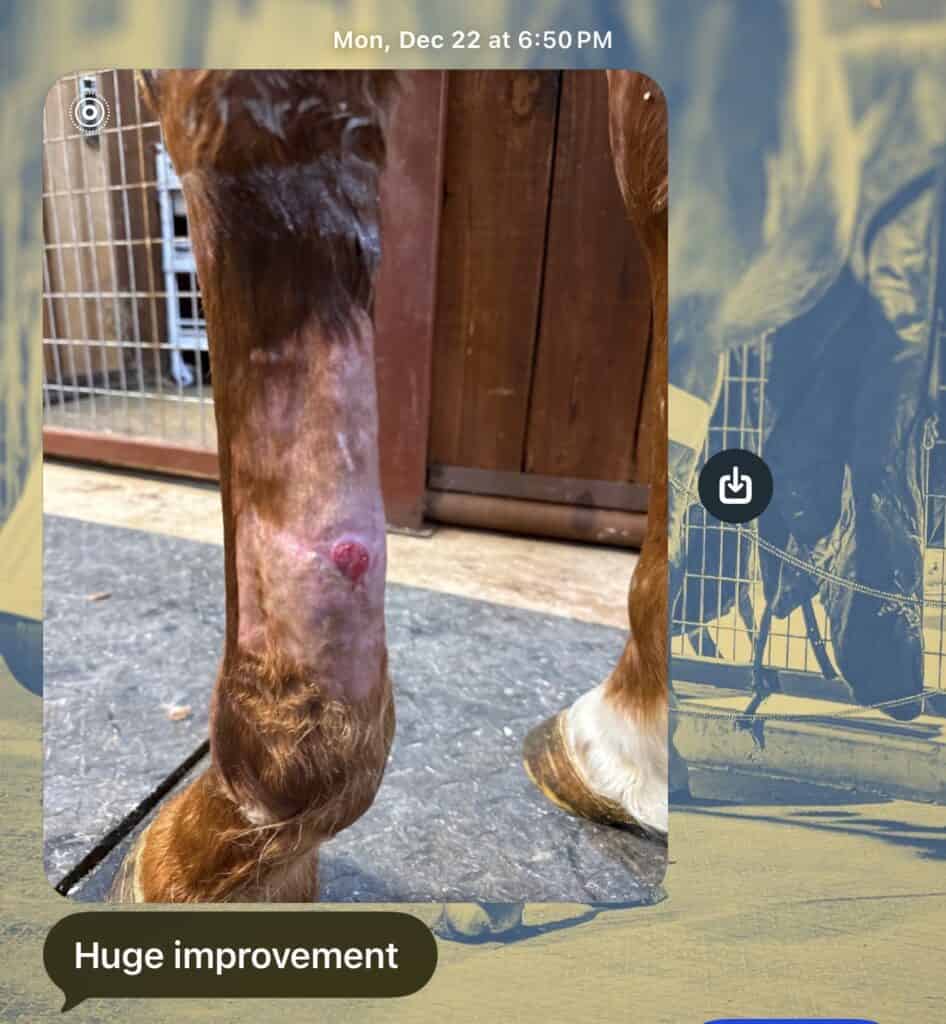
Mop tried to remodel her leg this fall.
Not a little knock. A full-on “why are you like this?” kind of injury.
And it turned into a really good reminder of this:
Wound healing is soft-tissue healing.
And a lot of that is nutrition + materials, not just wraps and prayers.
Mop’s leg — the quick backstory
This wasn’t just skin. She got into DDFT + superficial territory and left a big, raw crater in a high-motion spot.
Timeline:
- 10/16 – Injury: cut her leg + hit DDFT and superficial
- 10/25 – Started Myopulse 2–3x/week
- 11/10 – Re-check: cleared on DDFT & superficial 🙌
- 11/24 – Added NutriSana EQ CORE
- 12/5 – Bumped to REBOUND (1.5× CORE) + started regional limb perfusions (RLPs) with antibiotics
This was soft tissue + wound management.
A wound like this is still a soft-tissue injury
We love to separate things like:
- “Soft tissue injury” = tendon/ligament
- “Cut/wound” = skin, wrap it, wait
But that’s not how the body works.
A wound like Mop’s is layers of soft tissue trying to sort their lives out:
- Skin
- Fascia
- Tiny vessels + nerves
- Connective tissue that has to glide and move every step
If you don’t support the whole system, you don’t just get “slow healing.”
You get messy collagen, proud flesh, fragile new skin that splits back open… and a leg that never really returns to normal.
So no—this wasn’t “just a cut.”
It was a whole soft-tissue recovery project, and her feed bucket had to be part of the plan.
What the body is doing when a wound heals
- Inflammation phase
Clean-up crew. Immune response. Bacteria control. - Proliferation phase
Filling the gap with granulation tissue + laying down new collagen. - Remodeling phase
Turning the “emergency patch” into stronger, organized tissue that can actually handle movement.
Every phase costs the body materials:
- Protein + key amino acids (lysine, methionine, threonine, glycine, etc.)
- Collagen building blocks
- Vitamin C, zinc, copper (collagen cross-linking + skin integrity)
- Antioxidant + anti-inflammatory support so it doesn’t stay stuck in “angry and swollen”
You can have perfect vet work and bandaging… but if the horse doesn’t have the raw materials?
You’re asking it to rebuild a barn with half the lumber missing.
Where nutrition + supplements came in for Mop
Here’s how I thought about it:
1) Forage first
Good hay, enough calories. Healing takes energy.
You can’t knit tissue together if the tank is empty.
2) Minerals balanced
Trace minerals run a ton of the enzyme systems behind healing, immunity, and collagen production.
3) CORE → REBOUND
CORE brought in:
- Daily collagen support
- Extra amino acids for rebuilding tendon/ligament/muscle/skin
- Botanical anti-inflammatory + antioxidant support (boswellia, rosehip, ginger, yucca, etc.)
- Gut + immune support so what I’m feeding actually gets absorbed and used
When I bumped her to REBOUND (1.5× CORE), it wasn’t a “more is more” ego move.
It was simple: her repair demand was high.
Big wound. Soft tissue underneath reorganizing. High-motion area.
So I matched her daily intake to what her leg was being asked to rebuild.
The stack
- RLPs handled the local antibiotic side and helped keep infection from turning this into a nightmare
- Myopulse helped with circulation, swelling, and keeping tissues from locking up
- Vet work handled the medical side
- Nutrition + CORE → REBOUND made sure her body had what it needed to rebuild quality tissue, not just “close the hole”
Why I call it supplement-based support
The goal isn’t just:
“Did it close?”
The real questions are:
- What kind of tissue did we build?
- How strong is it?
- Will it hold up when we go back to real work?
That’s where the feed bucket shows up.
Not as a miracle.
As daily materials:
- Collagen
- Amino acids
- Micronutrients
- Anti-inflammatory + antioxidant support
So the body can do what it’s already designed to do.
With Mop, it wasn’t overnight. But week by week, the leg got quieter, smaller, less angry, more “normal.”
That’s not luck. That’s stacked rehab.
